What Is Citizen Science? Definitions, History and the Main Types of Project
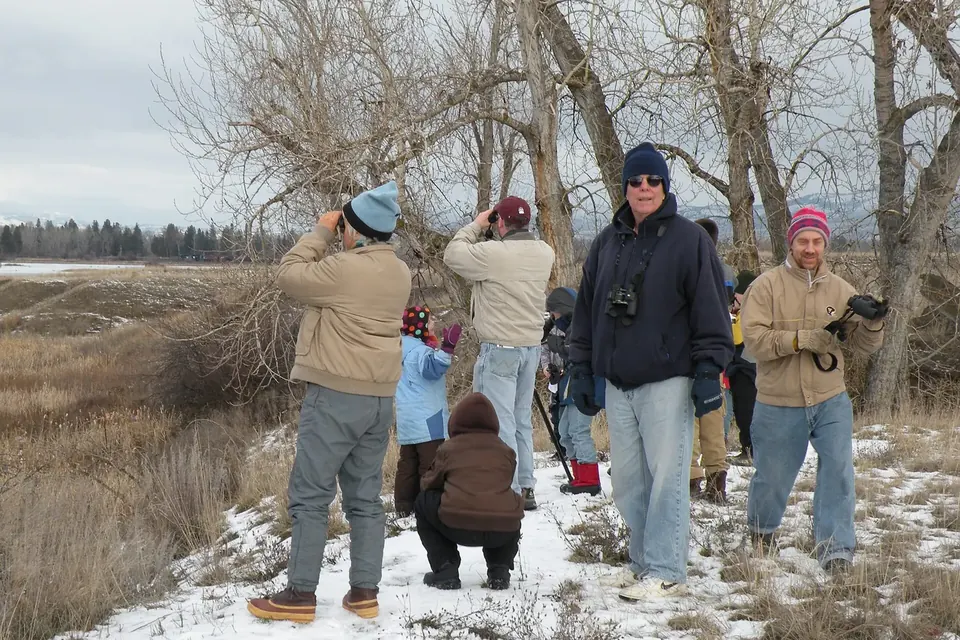
Citizen science is scientific research in which members of the public take part, most often by collecting or analysing data. It covers counting birds and butterflies, classifying galaxies on a laptop, measuring air pollution on a balcony, and residents designing their own study of a local problem. The term is broad and contested, but the basic idea is simple: science does not have to be done only by professional scientists.
Definitions and the origin of the term
Two meanings of "citizen science" emerged at about the same time in the mid-1990s. At the Cornell Lab of Ornithology, Rick Bonney used it to describe projects in which volunteers gathered bird data for scientific research. In the UK, the sociologist Alan Irwin's book Citizen Science: A Study of People, Expertise and Sustainable Development (1995) used it in a more political sense: a science that responds to citizens' concerns and recognises their knowledge. Both meanings survive. Some people now prefer terms such as "participatory science", "community science" or "public participation in scientific research", partly because "citizen" can wrongly suggest that nationality matters.
The Oxford English Dictionary added "citizen science" in 2014, defining it as scientific work undertaken by members of the general public, often in collaboration with or under the direction of professional scientists and scientific institutions.
A long history
People without scientific posts have contributed to science for centuries, from amateur astronomers to naturalists keeping diaries of flowering dates. A frequently cited early organised project is the Christmas Bird Count, proposed by the ornithologist Frank Chapman and first held on Christmas Day 1900 as an alternative to holiday bird hunts. It still runs every winter, organised by the National Audubon Society, and its long data series is used to study changes in bird populations.
The internet transformed the field. eBird, launched in 2002 by the Cornell Lab of Ornithology and the National Audubon Society, lets birdwatchers submit checklists from anywhere. Galaxy Zoo, launched in 2007 by astronomers at the University of Oxford and partners, asked volunteers to classify images of galaxies and grew into the Zooniverse platform, which hosts projects in many disciplines. Smartphone apps for recording wildlife, noise, light pollution or potholes followed.
The main types of project
Researchers have proposed several typologies. Two are especially widely used.
Contributory, collaborative and co-created
A 2012 framework by Jennifer Shirk and colleagues, building on an earlier report for the US Center for Advancement of Informal Science Education, classifies projects by how many steps of the research the public takes part in:
- Contributory projects: scientists design the study; the public mainly collects data. Most large biodiversity projects fall here.
- Collaborative projects: the public also helps refine the design, analyse data or share findings.
- Co-created projects: scientists and members of the public design the project together, and at least some participants are involved in nearly every step. Many projects started by communities facing an environmental problem are co-created.
The same paper also mentions contractual projects, in which communities ask professionals to carry out a study, and collegial projects, in which non-credentialed people do research largely on their own.
Levels of participation
Muki Haklay of University College London proposed in 2013 four levels: crowdsourcing (people as sensors or processors), distributed intelligence (people as basic interpreters), participatory science (people help define the problem and collect data) and "extreme citizen science" (collaboration throughout, including problem definition and analysis). These models echo older ladders of participation used in planning and development, discussed in our methods section.
What policy says
In the United States, the Crowdsourcing and Citizen Science Act, enacted in January 2017 as part of the American Innovation and Competitiveness Act, gave federal agencies explicit authority to use citizen science and crowdsourcing, and addressed questions such as data, volunteers' protection and reporting. The federal government maintains a catalogue of projects at CitizenScience.gov, and agencies such as the National Park Service run their own programmes.
Internationally, the UNESCO Recommendation on Open Science, adopted by UNESCO's General Conference in November 2021, includes the open engagement of societal actors, including citizen and participatory science, among the pillars of open science. In Europe, the European Citizen Science Association published "Ten Principles of Citizen Science" in 2015, covering issues such as genuine scientific outcomes, feedback to participants, data openness and acknowledgment of volunteers.
What volunteers do, and what they get
Typical tasks include recording observations with a standard protocol, taking samples (water, soil, air), transcribing historical documents, classifying images or sounds online, and, in co-created projects, designing studies and presenting results to authorities. Volunteers report many motivations: curiosity, concern about a local issue, learning, social contact and the wish to contribute to something useful. Good projects respect that time by:
- explaining clearly what the data will be used for and who will have access;
- providing training and feedback on the quality of contributions;
- reporting results back in accessible language;
- crediting volunteers in publications where appropriate;
- being honest about what volunteers can and cannot influence.
Is citizen science reliable?
The quality of citizen science data has been studied extensively. The answer depends on the task, the training and the checks built into the project. Many projects achieve accuracy comparable to professionals for well-defined tasks; others need statistical correction for differences in observer skill or effort. Our article on data quality in citizen science explains the methods projects use. For environmental monitoring by residents, see our guide to community air quality monitoring; for what happens to the data afterwards, see open and community data.
How to choose a project
- Check who runs it: a university, a public agency, a museum or a registered charity should say so clearly.
- Read the data policy: who owns contributions, whether they will be published openly, and how personal data such as your location are protected.
- Look for feedback: do past volunteers see results, publications or reports?
- Consider the level of involvement you want, from a few minutes online to a year-long community study.
Sources
- Alan Irwin, Citizen Science: A Study of People, Expertise and Sustainable Development, Routledge, 1995.
- Jennifer L. Shirk et al., "Public participation in scientific research: a framework for deliberate design", Ecology and Society, vol. 17, no. 2, 2012, art. 29.
- Muki Haklay, "Citizen science and volunteered geographic information: overview and typology of participation", in D. Sui, S. Elwood and M. Goodchild (eds.), Crowdsourcing Geographic Knowledge, Springer, 2013.
- American Innovation and Competitiveness Act, Public Law 114-329, section 402 (Crowdsourcing and Citizen Science Act), January 2017.
- UNESCO, Recommendation on Open Science, adopted 23 November 2021.
- European Citizen Science Association, "Ten Principles of Citizen Science", 2015.
 Citizen science & data
Data quality in citizen science
Protocols, training, validation, consensus and statistics: the toolkit that makes volunteer data usable by scientists and regulators.
 Citizen science & data
Community air quality monitoring
What low-cost sensors can and cannot tell you, how to site and check them, and how resident data reach decision-makers.
 Citizen science & data
Open and community data, shared responsibly
Report-back to participants, open licences, anonymisation and repositories: a practical guide to sharing community research data without harm.